


Protocols
Unit 8 Summary - Part 3

Computer communication standards:
All hardware must be designed to be able to communicate to other devices.
Examples of standards: ASCII, Unicode, etc.
Protocols:
are rules about how signals are prepared, sent and received over networks.


Ethernet
is wired.
Ethernet is a protocol system for transmitting data in a wired network.
Data are broken up into packets and sent to the right computer address.
Ethernet Alliance is a non-profit organisation that checks equipment and promotes the Ethernet system.


Wi-Fi
is wireless.
Wi-Fi is a protocol system for wireless network. A wireless local area network is called a WLAN.
Wi-Fi Alliance is a non-profit organisation that tests devices to make sure they are Wi-Fi compatible.
Devices that pass the test are called Wi-Fi certified.

TCP/IP
is a group of standards and protocols for high speed links over WAN.
TCP/IP was developed in 1969 by DARPA (a US government agency).
TCP/IP is sometimes called DARPA model. It has 4-layer model:
-
application layer
-
transport layer
-
network layer
-
link layer
Application layer
involves applications ((just like the name) such as web browsers, email app, etc.
It contains protocols that make common internet applications work.
The most common application layer protocols:
-
HTTP: hypertext transfer protocol.
-
HTTPS: hypertext transfer protocol - secure
-
FTP: file transfer protocol
-
SMTP: simple mail transfer protocol
-
IMAP: internet message access protocol


HTTP: hypertext transfer protocol
HTTP defines hyperlinks in a webpage; when a user clicks on the hyperlinks, the web browser moves to different webpages, or websites, or around the internet.
Your browser will display http://
HTTPS: hypertext transfer protocol - secure
HTTPS is a secure version of HTTP as it has encryption. It encrypts your message before it's sent over the internet to stop hackers reading your message.
Your browser will display https://
FTP: file transfer protocol:
is an old protocol of HTTP, it doesn't have pictures/videos/music. FTP is a way of getting files from another computer. The computer that has the file is called the server, the computer that downloads is called the client.
SMTP: simple mail transfer protocol
is a mail delivery protocol to send emails and to attach files to emails. SMTP doesn't fetch email addresses, it only sends emails.
IMAP: internet message access protocol
is a protocol to fetch emails and store them in an inbox. Email domain companies store your emails on a mail server.
Gmail and Outlook use IMAP.


Transport layer
establishes the connection between 2 servers, it ensures both computers/web hosts use the same setting, the same language, & the same data packets size.
Also called as host-to-host transport layer as it controls the communications at the 2 ends only (transport layer doesn't deal with smaller links).
-
TCP:
allows computers at the 2 ends to send/receive data.
TCP makes sure accurate transmission, not speed.
-
UDP:
reduce error-checking, and works more quickly.
Only suitable when the message is short, and the connection is very reliable.

Network layer / Internet layer
takes care of the detailed connections between the transmission (unlike transport layer).
A message must pass through many different connections (such as smaller networks, servers, and routers) on its route before it reaches its destination.
Network layer is also called Internet layer.
IP
the most important protocol in network layer, it makes sure every message gets to the right Internet Address.
Every computer has an IP address.
Messages are split into packets, sent down on an internet route to the IP address.
Then the packets are put together.


Link layer
converts the messages from the TCP/IP model into LAN/computer system form.


Oxford AQA IGCSE 2019
03.4.
A protocol is a set of rules that allows devices to communicate. Tick (√) one box to show which protocol would be used to retrieve email stored on a server. [1 mark]

Answer:
IMAP
03.5.
Tick (√) one box to show which protocol would be the best choice to use to make a payment securely when purchasing goods from a website. [1 mark]
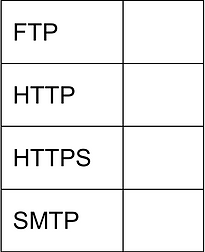
Answer:
HTTPS

Oxford AQA IGCSE 2020
09.
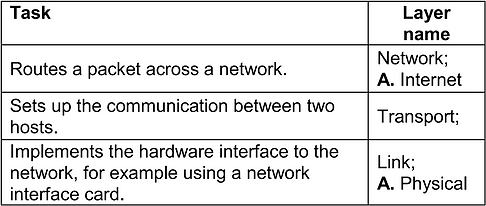
For each task listed in Table 1 name the layer of the TCP/IP stack at which the task box would take place. [3 marks]
Table 1

Answer:

Oxford AQA IGCSE Specimen Paper

08.
Figure 5 shows the TCP/IP stack that will be used by the network to send data from a transmitting device to a receiving device.
The names of two of the layers of the stack have been replaced by the letters A and B.
Figure 5


08.1.
What is the name of the layer that has the label A? [1 mark]
__________________________________________________________________________________
08.2.
What is the name of the layer that has the label B? [1 mark]
__________________________________________________________________________________
08.3.
Many different network protocols can be used at the application layer.
Explain what a protocol is. [2 marks]
__________________________________________________________________________________
08.4.
Two protocols used at the application layer are HTTP and IMAP.
Explain what HTTP is used for. [1 mark]
__________________________________________________________________________________
08.5.
Explain what IMAP is used for. [1 mark]
__________________________________________________________________________________
