


Pseudocode & Flowcharts
Unit 3 Summary - part 2


Pseudocode Summary


How Pseudocode works?


How to Write a Pseudocode?


IGCSE's Pseudocode

Oxford AQA IGCSE Specimen Paper

09.
Figure 6 shows an algorithm expressed using pseudo-code.
Figure 6

The variable Length contains the value 5, which is the number of items stored in array List.
The algorithm operates on an array called List. The current contents of array List are shown in Figure 7.
Figure 7


09.1.
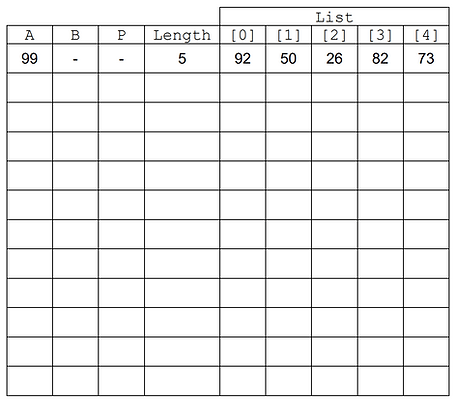
Complete the trace table below to show the execution of the algorithm in Figure 6 on the array contents in Figure 7.
The initial values of the variables, before the start of the FOR loop, have been written into the table to help you.
You may not need to write in all of the rows of the table. [6 marks]
09.2.
Explain the purpose of the algorithm in Figure 6. [1 mark]
__________________________________________________________________________________
09.3
The algorithm makes an assumption about the data in the array List.
If this assumption is not met the algorithm will not work.
Explain what this assumption is. [1 mark]
__________________________________________________________________________________

Oxford AQA IGCSE Mock Paper

03.
Figure 2 shows a standard search algorithm expressed using pseudocode.
Figure 2

The algorithm operates on an array called List. The current contents of array List are shown in Figure 3.
Figure 3


03.1.
Complete the trace table below to show the execution of the algorithm in Figure 2 on the array contents in Figure 3.
You may not need to write in all of the rows of the table. [4 marks]

03.2.
What is the name of the standard search algorithm shown in Figure 2? [1 mark]
__________________________________________________________________________________
03.3
The UNTIL loop will terminate if the condition B > E is true. Explain the purpose of this condition. [1 mark]
__________________________________________________________________________________
